
Abstract
Modern economic systems depend heavily upon the taxation of income, employment and productive activity to finance government expenditure. At the same time, they frequently rely upon expanding economic output, increasing employment and population growth to maintain public revenues, pension systems and social provision. These relationships present increasingly significant challenges as artificial intelligence, robotics and automation transform production, demographic structures change, and environmental constraints become more apparent.
The Consumption Tax Economy, proposed by Phil Markey in two complementary volumes published in 2026, examines whether these structural dependencies can be progressively reduced through a fundamental reorganisation of taxation, economic incentives and personal capital ownership.
The central hypothesis is that taxation should be directed principally towards the final consumption of wealth rather than its creation. Under the proposed framework, taxes on personal income and employment would be progressively reduced as a broad consumption-based tax assumed a greater share of public financing. Earnings retained for saving and productive investment would consequently face fewer direct fiscal obstacles, potentially encouraging capital formation, entrepreneurship, productivity improvements and the accumulation of personal wealth.
Unlike proposals for an immediate replacement of existing taxation, the Consumption Tax Economy envisages a gradual, evidence-dependent transition. Its illustrative thirty-year horizon is not a fixed timetable or a prediction of future economic conditions. Each stage would be conditional upon observed fiscal performance, household purchasing power, productive investment, economic growth and the continuing ability of government to finance its essential obligations.
The first volume, The Consumption Tax Economy: A New Economic Model for Britain, examines the practical and fiscal implications of this transition within the British economy. It considers the relationship between taxation and productive incentives, the financing of public expenditure, international trade, inflation, household welfare, retirement provision and the consequences of changing the principal source of government revenue.
The second volume, Mature Consumption Tax Economy: An Economic Model for a Sustainable Future, extends the hypothesis beyond tax reform to investigate the structure of an economy in which these changes have substantially matured.
A central question concerns the future relationship between human employment and economic participation.
Artificial intelligence and increasingly autonomous productive technologies may enable substantial increases in output while reducing the human labour required to produce it. Conventional economic arrangements distribute much of the population's purchasing power through employment income. If productive activity becomes increasingly automated, the relationship between production, wages, household consumption and government revenue may consequently become less reliable.
The Mature Consumption Tax Economy examines an alternative in which individuals increasingly participate in productive activity through the ownership of capital, rather than depending exclusively upon the sale of their labour.
Within this framework, greater retention of earnings during the transition could facilitate the accumulation of productive assets. Income subsequently generated by those assets could supplement or partially replace employment income, allowing individuals to maintain purchasing power as automation changes the demand for human labour.
The distribution of productive ownership is therefore a central consideration. Technological productivity alone cannot guarantee widespread prosperity if the resulting economic returns become concentrated among a limited number of owners. The model examines the relationship between capital accumulation, ownership distribution, household financial independence and the continuing circulation of purchasing power through the economy.
This raises a broader question about the purpose of economic development.
If increasing productivity allows greater economic value to be produced with fewer workers, prosperity need not necessarily depend upon maintaining an ever-expanding workforce. Similarly, improvements in productive efficiency, durability and the composition of economic activity may permit higher living standards without requiring equivalent increases in material consumption.
The proposed mature economy consequently explores the possibility of maintaining prosperity alongside demographic stability or gradual population reduction, while recognising that such outcomes depend upon productivity, ownership, fiscal capacity and other measurable economic conditions.
Retirement and social provision are also reconsidered within this framework. Greater accumulation of personal capital could progressively reduce dependence upon employment-based pension contributions and permanent state retirement transfers. Nevertheless, the model retains a social safety floor for individuals and households unable to meet their essential needs. Financial independence is treated as a desirable economic outcome rather than a universal assumption.
The framework also distinguishes between private financial independence and the responsibilities of government. It proposes that individuals capable of supporting themselves should ordinarily retain financial privacy, while public assistance necessarily requires an assessment of genuine need.
Neither volume presents the Consumption Tax Economy as an established economic law or guarantees that its anticipated outcomes will occur.
The accompanying economic models examine alternative assumptions concerning productivity, taxation, government expenditure, population, automation, investment, capital ownership and household consumption. Particular attention is given to identifying circumstances in which the proposed transition would become fiscally unsustainable, economically counterproductive or socially undesirable.
The central methodological principle is that the economic system must respond to observed evidence rather than requiring evidence to conform to a predetermined political objective. A transition that produces beneficial results only up to a particular point should stop at that point. A mechanism that fails must be modified, and a hypothesis contradicted by sufficient evidence must be rejected.
The Consumption Tax Economy therefore proposes more than a different method of collecting taxation. It investigates whether changes in fiscal incentives, capital formation and productive ownership could support a longer-term transformation in the relationship between individuals, technology, government and economic prosperity.
Its ultimate objective is not the maximisation of employment, population, taxation or material consumption, but the sustainable improvement of human living standards and financial independence.
The complete theoretical framework, fiscal modelling, transition mechanisms, sensitivity analyses and examination of potential failure conditions are presented in the two published volumes.
Principal publications
These books contain the detailed reasoning, quantitative models and tests underpinning the proposed framework. The abstract above is an introduction, not a substitute for the complete research.
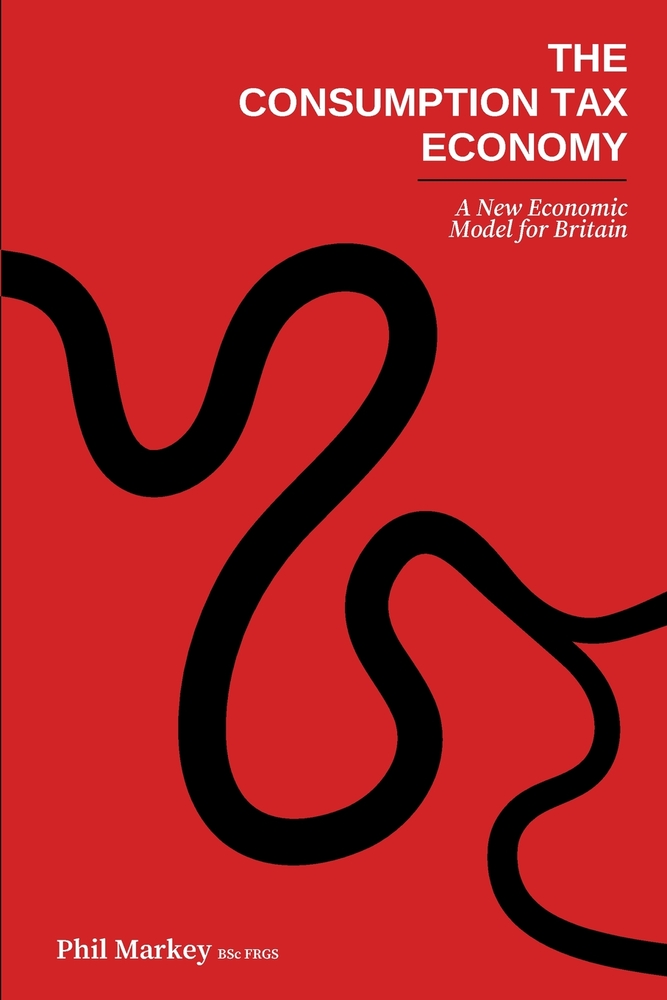
The Consumption Tax Economy
A New Economic Model for Britain
The fiscal transition, economic incentives, public finances, trade, household effects, scenarios and implementation tests.
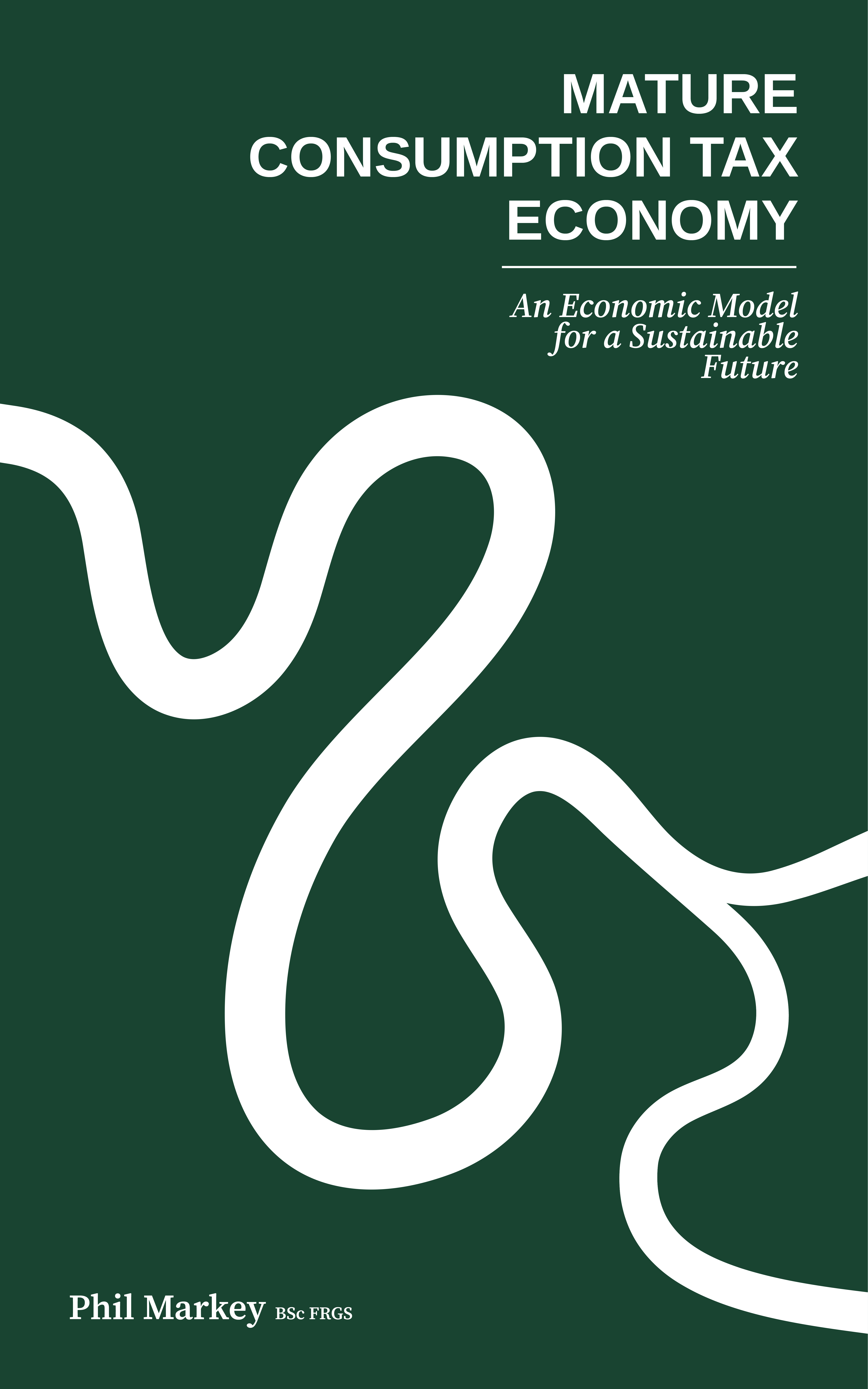
Mature Consumption Tax Economy
An Economic Model for a Sustainable Future
The mature economy, capital ownership, AI and robotics, retirement, the safety floor, demographic change and stress tests.
Purchase links offer 20% off the stated retail prices. Taxes, delivery charges and availability are confirmed by IngramSpark at checkout.
This public research abstract outlines the author's proposed hypothesis. It does not constitute peer-reviewed validation, economic policy advice or a reproduction of the books' complete analyses.