
Araucaria araucana
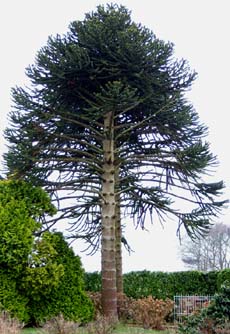
Family: Araucariaceae Species
Common Name: Monkey Puzzle
Scientific Synonymy:
Pinus araucana, Dombeya chilensis, Columbea quadrifaria, Abies araucana, Araucaria chilensis, Araucaria imbricata, Abies columbaria, Araucaria dombeyi, Columbea imbricata
Common Synonymy:
Chilean Pine. German: Araukarie, Chilen Tanne. Spanish: Araucaria, Pino Araucana, Pino Chileno, Piñonero.
Cold Hardiness Zone: 7b View the UK and US zone maps
Araucaria araucana Information
Identification
General Information
'Monkey puzzle' is a name thought up by a Cornish joker at Pencarrow garden near Bodmin in Cornwall who remarked, after pricking his fingers on the foliage: 'It would puzzle a monkey to climb that tree'. The scientific name is drawn from the Araucano and Pehuenche people, who gather its seed as a staple food. Many animals also feed upon the seeds, which together with widespread deforestation through logging and fires the species has become endangered, and classified as vulnerable on the IUCN Red List 2007, and listed on Appendix I of CITES.
Conservation:
Araucaria araucana was declared a National Monument in Chile in 1976, a status that prohibits logging. The species is also protected in Argentina although logging pressure continues outside of National Parks. Rainforest Concern (London, UK), with the co-ordination of UACh and Royal Botanical Garden Edinburgh (UK), carried out the purchase of 161,5 ha of A. araucaria forests for their conservation in January 2004.
Distribution
Native to: Chile
Endemic to Chile and Argentina in South America. Found in the Andes Mountains that separate these two countries. The range extends from 900 metres above sea level to the tree line at 1,800 metres. Two additional populations are found in the coastal mountain range of Chile known as the Cordillera de Nahuelbuta; these coastal populations are thought to be genetically distinct from the Andean trees. The total area of A. araucana forest types in Chile is of 253,713.6 ha. Approximately, 97% of this area is situated in the Andean Range, and only 2.9% occurs in the Coastal Range. Approximately, 65.9% of the A. araucana forests in the Coastal Range are situated in private properties. This population is currently unprotected by the State. These trees cast a unique vista in the mountainous regions where they are found, their tall, straight trunks being highly unusual at altitude. They are often found in mixed forests with the deciduous Nothofagus pumilio; the taller monkey puzzle trees emerging above the canopy of these smaller natives.
Location: Chile (-38.630753°N, -72.057213°E)
Observations
Map may not represent the complete natural distribution. (Markers display observation data).
Araucaria araucana distribution overlay © 2026 Trebrown.