
Jubaea chilensis
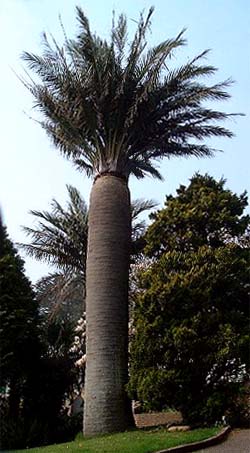
Family: Arecaceae Palm Tree
Common Name: Chilean Wine Palm
Scientific Synonymy:
Palma chilensis, Cocos chilensis, Molinaea micrococo, Micrococos chilensis, Jubaea spectabilis
Common Synonymy:
Chilean cocopalm, Coquito palm, Honey palm, Syrup palm, Wine palm. French: Cocotier du Chili. German: Chilenische Honigpalme, Honigpalme. Italian: Iubea. Spanish: Coco de Chile, Palmera coquito, Palmera del vino
Cold Hardiness Zone: 7b View the UK and US zone maps
Jubaea chilensis Information
A solitary, massive, moderately slow growing, monoecious palm. Common in cultivation and scarce in the wild. It has a smooth, dark-grey trunk, 24.5 m. (80 ft.) tall, 183 cm. (72 inch) diameter with diamond-shaped leaf scars, and large segmented, pinnate (feather) leaves, 3.7 m. (12 ft.) long, 1.2 m. (4 ft.) wide, dull green above and greyish green beneath.
Not recommended for hot, humid climates, it grows slow, is never as large or beautiful, and tends to die out because of year-round high heat and humidity. It much prefers cooler climates.
Jubaea chilensis can tolerate freezing temperatures to about -15°C (5°F). It naturally occurs in open, sun exposed, montane or lowland hilly locations, and should be planted to maximise sunshine exposure. Under extreme freezing conditions we recommend you keep this palm as dry as possible, which will usually mean constructing a glass or plastic roof over the plant to keep rain off. Any cover placed over this palm during times of rain or during cold nights must be removed or vented during hours of sunshine or the plant could be severely heat exhausted.
General Information
Distribution
Native to: Chile
Formerly more common in Chile between 32° and 35°S but now confined to a few remnant populations, principally La Campana National Park and near Cocalán.
Location: Chile (-34.359158°N, -71.147461°E)
Observations
Map may not represent the complete natural distribution. (Markers display observation data).
Jubaea chilensis distribution overlay © 2026 Trebrown.