
Corypha taliera
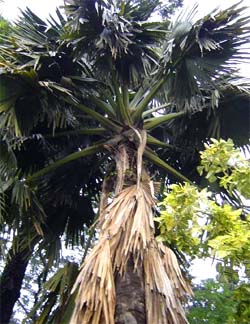
Family: Arecaceae Palm Tree
Common Name: Tali
Scientific Synonymy:
Taliera bengalensis, Taliera tali, Corypha martiana, Corypha careyana
Cold Hardiness Zone: 10b View the UK and US zone maps
Corypha taliera Information
A solitary, massive, moderately slow growing, monoecious palm. Not known in cultivation and extinct in the wild. It has a rough, grey-brown trunk, 27.5 m. (90 ft.) tall, 91.5 cm. (36 inch) diameter with no obvious leaf scars, and massive partially segmented, palmate (fan) leaves, 6 m. (20 ft.) long, 6 m. (20 ft.) wide, dark green above and beneath.
The leaves are circular costapalmate and carried on 3 m. long stout petioles armed with black teeth. These, together with C. umbraculifera's hold the record of the largest palmate leaves of any plant. The main identification characteristic of C. taliera is that the tree has no persistent leaf-bases when young, unlike other Corypha species which hold huge rhino horn shaped leaf-bases for many years before shedding them to reveal a rough grey trunk.
Corypha taliera naturally occurs near streams in valley bottoms, which are often at reasonable altitude. Therefore, one would assume this palm would tolerate some cold conditions. However, valley bottoms are very sheltered and nearby water can artificially raise the air temperature. Close to freezing temperatures can kill this palm. But this palm tolerates a constantly mild climate with little temperature difference between day & night, and Summer & Winter. Under extreme cold conditions we recommend you keep this palm as dry as possible, well wrapped up, and possibly provide additional heat.
General Information
The palm in the scrub jungle on the Dhaka University campus is now flowering (2009), and will soon die after seeding.
Distribution
Native to: Bangladesh, India